Risk Assessment
For any work activities involving dangerous substances, this is the main risk assessment module in DSEAR and there are several guidance documents to assist in the process of area classification.
European Standards EN 60079-10
Institute of Petroleum Model code of Safe Practice IP15 (Petroleum Products)
Institute of Gas Engineers Safety Recommendations IGE/SR/25 (Natural Gas)
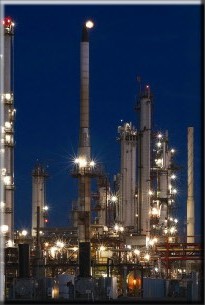
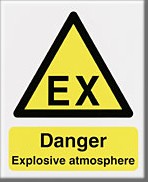
The various areas within a DSEAR Site must be appropriately identified and signage must be in use where personnel have access to hazardous areas.
Typically, where pedestrian acces is needed then an example sign might be as shown here.
Provide measures to eliminate or reduce, so far as reasonably practicable,the risks
Risk evaluation is of primary importance, as this assists in removing unnecessary processes and functions from the hazardous areas, so minimising the impact on plant and equipment.
Classify and zone places where explosive atmospheres may occur
Where hazardous areas do remain then any equipment which may present a hazard that will be used within it must be assessed, approved or certified in some measure, depending upon the severity of the risk.
Provide equipment and procedures to deal with accident and emergencies
Many hazardous sites are themselves located along side other dangerous sites and may even be close to residential areas.
The regulations require companies to put in place sufficiently robust accident and emergency procedures to deal with any event should it arise.This may involve outside agencies, such as fire authorities, police, emergency services etc..
Provide information and training to employees
Identification of pipes and containers where these contain dangerous substances
One of the main areas in the regulations is the process of identification, where a flammable substance or hazardous situation may occur
Then it is important to identify these areas, along with any residual risk areas identified in the risk assessment.
Therefore appropriate signage must be used.
Duty of coordination
A key area of the regulations is the requirement for the duty of co-ordination, which involves establishing the correct protocols within a company to manage the risk.
This includes training staff, liasing with senior management and outside agencies thus ensuring a central point exists with the company where information may be obtained.
To find out more contact us to see how we can help you implement a suitable Compliance Strate
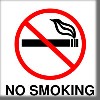
One must not forget the obvious signs, where these are needed
Equipment usage in hazardous areas
Equipment designed, and, where necessary, equipped with additional special means of protection affording a high level of protection.
Where a hazardous area is present, the equipment used must be suitable for those conditions of use, for further details regarding equipment usage and protection concepts employed see ATEX Equipment Concepts section